Father Sergius
eBook 정보
"Father Sergius," or "Отец Сергий" in Russian, was written between 1890 and 1898, and published posthumously in 1911. Its initial publication appeared in the second volume of Vladimir Chertkov's edited posthumous works, though Russian censorship mandated the omission of any mention of Emperor Nicholas I's love affair, a detail restored in the 1912 Berlin edition. The story's genesis is linked to Maria Pavlovna Chekhova's account of a young man who unexpectedly became a monk, a story that greatly intrigued Tolstoy. The plot centers on Prince Stepan Kasatsky, a former nobleman who, upon discovering his fiancée was the Emperor's mistress, quits military service to become a monk, eventually rising to the rank of priest monk, Father Sergius.
The composition delves into themes of temptation, spiritual struggle, and the true essence of faith, as Father Sergius faces several trials, including a sensual encounter with a merchant's daughter, Marja. His later departure from the hermitage and search for his childhood friend Pashenka lead him to a realization: true service to God lies not in seeking worldly fame or rigid asceticism, but in humble work and teaching. He finally finds himself in Siberia, working as a gardener and instructing children. This work preaches Christian altruism as the meaning of life, presenting it as a resolution to the social and moral problems that preoccupied Tolstoy in the late 19th century.
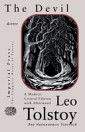
This critical reader's edition presents a modern translation of the original manuscript, crafted for the modern reader with clean, modern language and simplified sentence structures that clarify his difficult Russian phrasing and specific antiquated references. Supplementary material enriches the text with autobiographical, historical, and linguistic setting, including an afterword by the translator on Tolstoy's personal history, impact, and intellectual legacy, an index of the philosophical concepts he employs, giving attention to Existentialism and influence by Schopenhauer, a complete chronological list of his published writings, and a detailed timeline of his life, showing the personal relationships that shaped his philosophy.