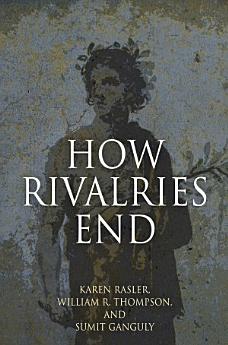
How Rivalries End
März 2013 · University of Pennsylvania Press
E-Book
280
Seiten
Tools
info
family_home
Zulässig
info
Über dieses E-Book
Rivalry between nations has a long and sometimes bloody history. Not all political opposition culminates in war—the rivalry between the United States and the Soviet Union is one example—but in most cases competition between nations and peoples for resources and strategic advantage does lead to violence: nearly 80 percent of the wars fought since 1816 were sparked by contention between rival nations. Long-term discord is a global concern, since competing states may drag allies into their conflict or threaten to use weapons of mass destruction. How Rivalries End is a study of how such rivalries take root and flourish and particularly how some dissipate over time without recourse to war.
Political scientists Karen Rasler, William R. Thompson, and Sumit Ganguly examine ten political hot spots, stretching from Egypt and Israel to the two Koreas, where crises and military confrontations have occurred over the last seven decades. Through exacting analysis of thirty-two attempts to deescalate strategic rivalries, they reveal a pattern in successful conflict resolutions: shocks that overcome foreign policy inertia; changes in perceptions of the adversary's competitiveness or threat; positive responses to conciliatory signals; and continuing effort to avoid conflict after hostilities cease. How Rivalries End significantly contributes to our understanding why protracted conflicts sometimes deescalate and even terminate without resort to war.
Political scientists Karen Rasler, William R. Thompson, and Sumit Ganguly examine ten political hot spots, stretching from Egypt and Israel to the two Koreas, where crises and military confrontations have occurred over the last seven decades. Through exacting analysis of thirty-two attempts to deescalate strategic rivalries, they reveal a pattern in successful conflict resolutions: shocks that overcome foreign policy inertia; changes in perceptions of the adversary's competitiveness or threat; positive responses to conciliatory signals; and continuing effort to avoid conflict after hostilities cease. How Rivalries End significantly contributes to our understanding why protracted conflicts sometimes deescalate and even terminate without resort to war.
Rivalry between nations has a long and sometimes bloody history. Not all political opposition culminates in war—the rivalry between the United States and the Soviet Union is one example—but in most cases competition between nations and peoples for resources and strategic advantage does lead to vi...
Mehr entdecken
Autoren-Profil
Karen Rasler and William R. Thompson, Professors of Political Science at Indiana University, have cowritten many books, including Strategic Rivalry: Space, Position, and Conflict Resolution in World Politics. Sumit Ganguly is Rabindranath Tagore Professor of Indian Cultures and Civilizations, and Director of the Center on American and Global Security, at Indiana University. He is the author, most recently, of Conflict Unending: Indo-Pakistani Tensions Since 1947.
Karen Rasler and William R. Thompson, Professors of Political Science at Indiana University, have cowritten many books, including Strategic Rivalry: Space, Position, and Conflict Resolution in World Politics. Sumit Ganguly is Rabindranath Tagore Professor of Indian Cultures and Civilizations, and...
Dieses E-Book bewerten
Deine Meinung ist gefragt!
Informationen zum Lesen
Smartphones und Tablets
Nachdem du die Google Play Bücher App für Android und iPad/iPhone installiert hast, wird diese automatisch mit deinem Konto synchronisiert, sodass du auch unterwegs online und offline lesen kannst.
Laptops und Computer
Im Webbrowser auf deinem Computer kannst du dir Hörbucher anhören, die du bei Google Play gekauft hast.
E-Reader und andere Geräte
Wenn du Bücher auf E-Ink-Geräten lesen möchtest, beispielsweise auf einem Kobo eReader, lade eine Datei herunter und übertrage sie auf dein Gerät. Eine ausführliche Anleitung zum Übertragen der Dateien auf unterstützte E-Reader findest du in der Hilfe.


