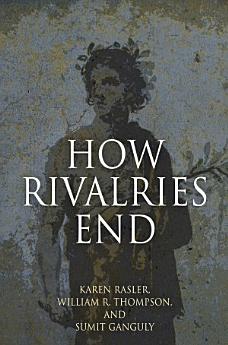
How Rivalries End
2013년 3월 · University of Pennsylvania Press
eBook
280
페이지
도구
info
family_home
적용 가능
info
eBook 정보
Rivalry between nations has a long and sometimes bloody history. Not all political opposition culminates in war—the rivalry between the United States and the Soviet Union is one example—but in most cases competition between nations and peoples for resources and strategic advantage does lead to violence: nearly 80 percent of the wars fought since 1816 were sparked by contention between rival nations. Long-term discord is a global concern, since competing states may drag allies into their conflict or threaten to use weapons of mass destruction. How Rivalries End is a study of how such rivalries take root and flourish and particularly how some dissipate over time without recourse to war.
Political scientists Karen Rasler, William R. Thompson, and Sumit Ganguly examine ten political hot spots, stretching from Egypt and Israel to the two Koreas, where crises and military confrontations have occurred over the last seven decades. Through exacting analysis of thirty-two attempts to deescalate strategic rivalries, they reveal a pattern in successful conflict resolutions: shocks that overcome foreign policy inertia; changes in perceptions of the adversary's competitiveness or threat; positive responses to conciliatory signals; and continuing effort to avoid conflict after hostilities cease. How Rivalries End significantly contributes to our understanding why protracted conflicts sometimes deescalate and even terminate without resort to war.
Political scientists Karen Rasler, William R. Thompson, and Sumit Ganguly examine ten political hot spots, stretching from Egypt and Israel to the two Koreas, where crises and military confrontations have occurred over the last seven decades. Through exacting analysis of thirty-two attempts to deescalate strategic rivalries, they reveal a pattern in successful conflict resolutions: shocks that overcome foreign policy inertia; changes in perceptions of the adversary's competitiveness or threat; positive responses to conciliatory signals; and continuing effort to avoid conflict after hostilities cease. How Rivalries End significantly contributes to our understanding why protracted conflicts sometimes deescalate and even terminate without resort to war.
Rivalry between nations has a long and sometimes bloody history. Not all political opposition culminates in war—the rivalry between the United States and the Soviet Union is one example—but in most cases competition between nations and peoples for resources and strategic advantage does lead to vi...
콘텐츠 둘러보기
저자 정보
Karen Rasler and William R. Thompson, Professors of Political Science at Indiana University, have cowritten many books, including Strategic Rivalry: Space, Position, and Conflict Resolution in World Politics. Sumit Ganguly is Rabindranath Tagore Professor of Indian Cultures and Civilizations, and Director of the Center on American and Global Security, at Indiana University. He is the author, most recently, of Conflict Unending: Indo-Pakistani Tensions Since 1947.
Karen Rasler and William R. Thompson, Professors of Political Science at Indiana University, have cowritten many books, including Strategic Rivalry: Space, Position, and Conflict Resolution in World Politics. Sumit Ganguly is Rabindranath Tagore Professor of Indian Cultures and Civilizations, and...
이 eBook 평가
의견을 알려주세요.
읽기 정보
스마트폰 및 태블릿
노트북 및 컴퓨터
컴퓨터의 웹브라우저를 사용하여 Google Play에서 구매한 오디오북을 들을 수 있습니다.
eReader 및 기타 기기
Kobo eReader 등의 eBook 리더기에서 읽으려면 파일을 다운로드하여 기기로 전송해야 합니다. 지원되는 eBook 리더기로 파일을 전송하려면 고객센터에서 자세한 안내를 따르세요.


